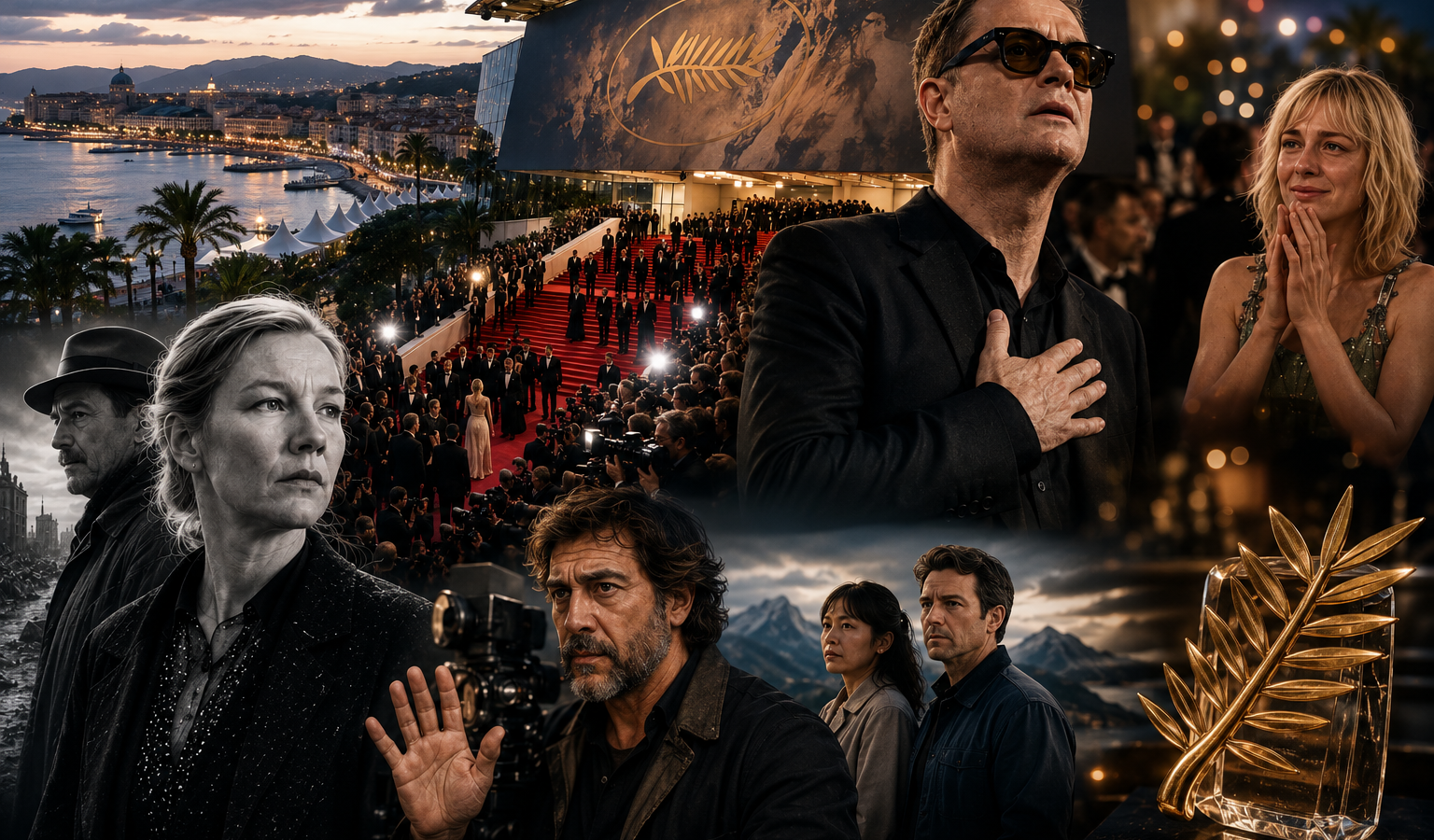
As the 79th Cannes Film Festival enters its final stretch, a handful of films have risen above a stacked competition lineup — led by Paweł Pawlikowski’s luminous “Fatherland” and the emotional return of Nicolas Winding Refn.
By The Hollywood Breaking Staff · May 19, 2026 · 10 min read
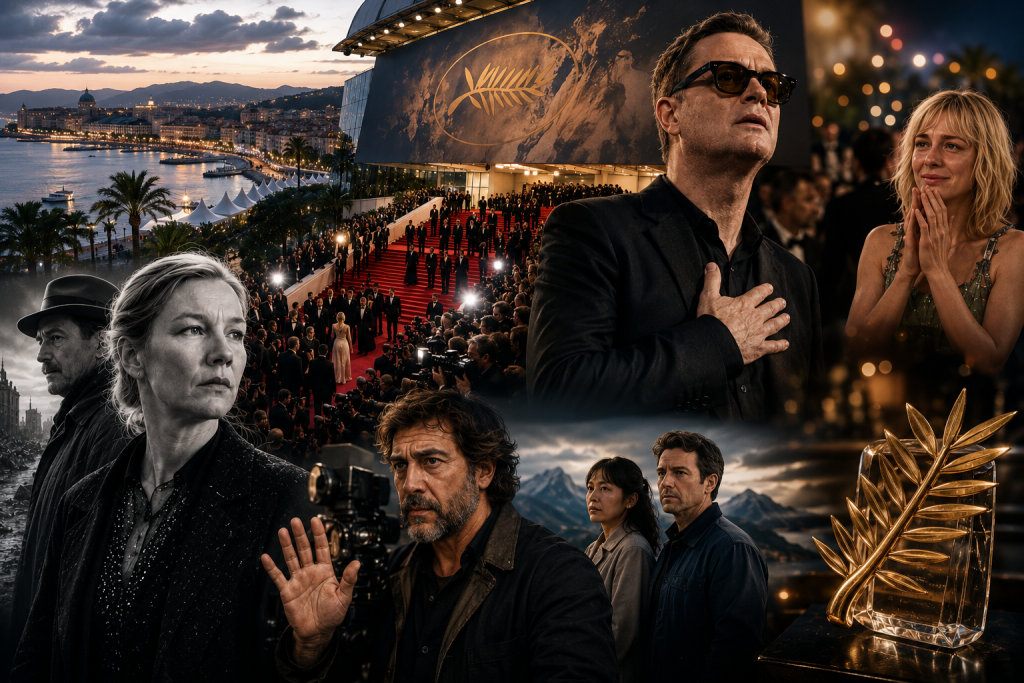
The Croisette has never been short on drama, but the 79th edition of the Cannes Film Festival — now in its second week with the closing ceremony set for Friday — has delivered the kind of charged, unpredictable atmosphere that reminds the world why this stretch of Mediterranean coastline remains the most important twelve days on the cinematic calendar. Drawn from more than 2,500 submissions spanning 141 countries, this year’s program arrived with weight: 22 films vying for the Palme d’Or, a jury led by South Korean auteur Park Chan-wook, and a festival president, Iris Knobloch, who acknowledged openly that the broader sense of uncertainty shaping the world right now makes the communal experience of cinema more valuable than ever.
What has followed is a festival that has felt less like a marketplace and more like a referendum on the state of the art form itself — a collision of veteran masters working at the peak of their powers, emerging voices demanding space, and at least one filmmaker who quite literally came back from the dead to screen his latest work.
Pawlikowski’s Masterclass Leads the Pack
If a single film has owned the conversation at Cannes this year, it is Paweł Pawlikowski’s Fatherland. The Polish filmmaker, who won Best Director at the festival in 2018 for Cold War, returns after an eight-year absence from narrative features with what critics are calling one of the most disciplined works of his career. Shot in striking black-and-white, the film follows Nobel Prize-winning writer Thomas Mann and his daughter Erika on a journey through the war-scarred Germany of 1949 — a road trip across a broken nation that manages, in just 82 minutes, to cut through the whole of postwar history.
Sandra Hüller, who won the Berlinale’s best actress prize earlier this year for Rose, delivers what reviewers have described as one of the most commanding performances of her career. Flanked by Hanns Zischler as Mann and August Diehl in a supporting role, the cast brings a grave emotional weight to Pawlikowski’s signature restraint — a style that keeps generous feelings on reserve until the final act, where they arrive all at once. The film currently sits atop the Screen International jury grid, the unofficial but closely watched critical barometer, and many observers consider it the frontrunner for the Palme d’Or.
“Fatherland is peak Pawlikowski. A masterclass in artistic discipline — it will be a hell of a movie that stands between this and the festival’s Palme d’Or.” — Deadline
Refn Returns — After Dying for 25 Minutes
If Fatherland represents the Cannes of meticulous craft and historical gravitas, then Nicolas Winding Refn’s Her Private Hell represents its opposite pole: feverish, sensory, divisive by design, and utterly impossible to ignore. The Danish filmmaker, who won the Best Director prize at Cannes in 2011 for Drive, has not released a feature since 2016’s The Neon Demon. The reason, as he revealed to a hushed audience after Monday night’s screening, is that he nearly didn’t survive to make another one.
Refn suffered severe heart failure several years ago, during which he was clinically dead for roughly 25 minutes before being resuscitated. The experience, he told the crowd, fundamentally changed him. The filmmaker described the film — a trippy, loosely connected series of vignettes starring Sophie Thatcher as a young woman searching for her father in a fog-consumed futuristic metropolis — as something born directly from that encounter with mortality. Thatcher, best known for Yellowjackets and Companion, was visibly moved to tears during the extended standing ovation that followed.
Reviews have been characteristically split. Some critics have hailed it as the only film at this year’s festival that genuinely interrogates what the future of cinema might look like, praising its hypnotic visual language and Pino Donaggio’s atmospheric score. Others have found it self-indulgent and structurally scattered. That tension is, of course, where Refn has always lived — and the ovation suggested the Cannes audience was happy to live there with him, at least for one night.
Mungiu, Bardem, and the Rest of the Race
The competition has been unusually deep. Cristian Mungiu, who won the Palme in 2007 for 4 Months, 3 Weeks and 2 Days, returned with Fjord, his first English- and Norwegian-language film. Starring Sebastian Stan and Renate Reinsve as deeply religious parents accused of child abuse in a small Norwegian town, the film received a 12-minute standing ovation — the longest of the festival — and has drawn praise for refusing to provide easy answers to the cultural tensions it depicts. Both Stan and Reinsve were reportedly in tears at the premiere.
Rodrigo Sorogoyen’s The Beloved, featuring Javier Bardem in what multiple critics have described as the performance of his career, has generated significant heat as well. The Spanish filmmaker’s first Cannes competition entry explores the dark side of filmmaking in a way that reviewers have compared favorably to Truffaut’s Day for Night. Ryusuke Hamaguchi’s All of a Sudden, his first film made outside Japan and running over three hours, sits just behind Fatherland on the critics’ grid. James Gray’s Paper Tiger, starring Adam Driver and Miles Teller, has also been praised for its quietly devastating emotional register.
Three Honorary Palmes — and a Streisand Finale
The festival has also made headlines beyond its competitive slate. In a rare gesture, three Honorary Palme d’Or awards have been conferred during this edition. Peter Jackson received his during the opening ceremony, honoring a career that spans from the visceral ingenuity of early New Zealand genre films to the epic scope of The Lord of the Rings trilogy. John Travolta received his on short notice ahead of the world premiere of Propeller One-Way Night Coach. And closing night will belong to Barbra Streisand — actress, director, and cultural institution — whose honor is expected to bring a fittingly grand conclusion to a festival that has been as much about legacy as it has about the future.
Meanwhile, the jury tasked with making the final call is itself a remarkable assembly. Alongside Park Chan-wook sit Chloé Zhao, Stellan Skarsgård, Ruth Negga, and Demi Moore — a group with the collective experience to read this competition’s many registers, from Pawlikowski’s austere formalism to Refn’s psychedelic excess and Mungiu’s slow-burning provocation.
What It All Means
Cannes has always been a barometer — not just for which films will dominate awards season, but for where cinema is heading. This year’s edition suggests that the art form is, in some ways, circling back to fundamentals. The strongest entries in competition are driven not by spectacle or intellectual property, but by singular directorial visions executed with conviction. Pawlikowski’s austerity, Mungiu’s moral complexity, Sorogoyen’s bravura storytelling, Refn’s sensory extremism — these are not films that could have been made by committee, and they are not films designed to function as content.
They are, instead, arguments for the irreplaceable power of the theatrical experience at a moment when that experience faces genuine existential questions. Festival president Knobloch said as much in her opening remarks, and the standing ovations — some stretching past ten minutes — have provided the punctuation. The closing ceremony on May 23 will reveal where Park Chan-wook’s jury lands. But regardless of which film takes home the Palme, the 79th Cannes has already made its point: cinema is not merely surviving. In the right hands, it is still capable of stopping a room.
The Palme d’Or Frontrunners
- Fatherland — Director: Paweł Pawlikowski — Sandra Hüller stars in Pawlikowski’s black-and-white portrait of Thomas Mann’s postwar Germany. Tops the Screen International jury grid and the critical consensus.
- All of a Sudden — Director: Ryusuke Hamaguchi — Hamaguchi’s first film outside Japan runs 3+ hours and sits just behind “Fatherland” on the critics’ grid. A measured, deeply layered work.
- Fjord — Director: Cristian Mungiu — Sebastian Stan and Renate Reinsve lead Mungiu’s culture-war drama set in Norway. Received the festival’s longest ovation at 12 minutes.
- Paper Tiger — Director: James Gray — Adam Driver and Miles Teller star in Gray’s latest piece of quietly devastating street-level melodrama. A Cannes competition regular delivers again.
- The Beloved — Director: Rodrigo Sorogoyen — Javier Bardem in what critics are calling his career-best performance. Compared to Truffaut’s “Day for Night” for its incisive look at filmmaking.
The 79th Cannes Film Festival closes May 23. Hollywood Breaking will report the full winners list as soon as the Palme d’Or jury announces its decisions.