David Ellison’s Paramount is swallowing Warner Bros. Discovery whole — combining HBO, CNN, DC, Harry Potter, and Game of Thrones under one roof with CBS, Top Gun, and SpongeBob. Over a thousand of Hollywood’s biggest names are trying to stop it.
By The Hollywood Breaking Staff · May 19, 2026 · 12 min read
In late February, after months of corporate warfare that pitted three of the most powerful companies in entertainment against one another, Paramount Skydance and Warner Bros. Discovery announced what many had suspected was coming but few truly believed would happen: a definitive merger agreement valued at approximately $111 billion, including debt. Paramount would acquire all of Warner Bros. Discovery for $31 per share in cash, combining two of Hollywood’s five remaining major studios into a single entity and creating what both companies described as a “next-generation global media and entertainment company.”
The deal was unanimously approved by both boards. WBD shareholders voted in favor on April 23. Regulatory review is ongoing, with a target close in the third quarter of 2026. And yet, in an industry defined by consolidation — an industry that watched Disney absorb 20th Century Fox just seven years ago — this merger has generated a backlash unlike anything Hollywood has seen in decades. More than 4,000 actors, directors, writers, producers, editors, and composers have signed open letters opposing it. Major stars including Joaquin Phoenix, Ben Stiller, Kristen Stewart, Bryan Cranston, David Fincher, Denis Villeneuve, Jane Fonda, JJ Abrams, Lin-Manuel Miranda, and Mark Ruffalo have put their names to the campaign. The website BlocktheMerger.com has become a rallying point. And the fundamental question at the heart of it all — whether bigger is better or simply bigger — remains unanswered.
How We Got Here
The road to this moment began with the quiet unraveling of Warner Bros. Discovery itself. WBD was formed in April 2022 through AT&T’s divestment of WarnerMedia and its subsequent merger with Discovery, Inc., under CEO David Zaslav. The union was troubled from the start. Debt was staggering. Streaming losses mounted. Linear cable networks continued their secular decline. By June 2025, Zaslav announced plans to split WBD into two separate companies — “Warner Bros.” and “Discovery Global” — by mid-2026. Industry analysts read the move as an implicit admission that the 2022 merger had underperformed. Others saw it for what it more practically was: a way to make Warner Bros., stripped of its cable baggage, an attractive acquisition target.
Paramount Skydance, now led by chairman and CEO David Ellison following the Skydance-Paramount merger completed earlier that year, recognized the opportunity. In September 2025, Ellison convened his board to discuss acquiring WBD. But he wasn’t the only suitor. Netflix, flush with over 325 million global subscribers and accelerating revenue growth, moved first. In December 2025, Netflix and WBD announced a $72 billion deal — later valued at roughly $83 billion — in which Netflix would acquire Warner Bros.’ studio and streaming assets, leaving the cable networks behind.
Paramount responded with a hostile counteroffer. Unlike Netflix, Ellison wanted the whole company — cable networks, CNN, and all. What followed was a months-long public battle: competing SEC filings, proxy solicitations, dueling press statements, and escalating price tags. Paramount raised its offer to $30, then to $31 per share. Netflix faced DOJ antitrust scrutiny over concerns its deal could create monopolistic conditions in the streaming market. By late February, WBD’s board declared Paramount’s revised bid a “superior proposal.” Netflix withdrew rather than prolong the fight. Paramount agreed to pay the $2.8 billion termination fee WBD owed Netflix for breaking the original deal. And just like that, the largest media merger in years was done — at least on paper.
What the Combined Company Looks Like
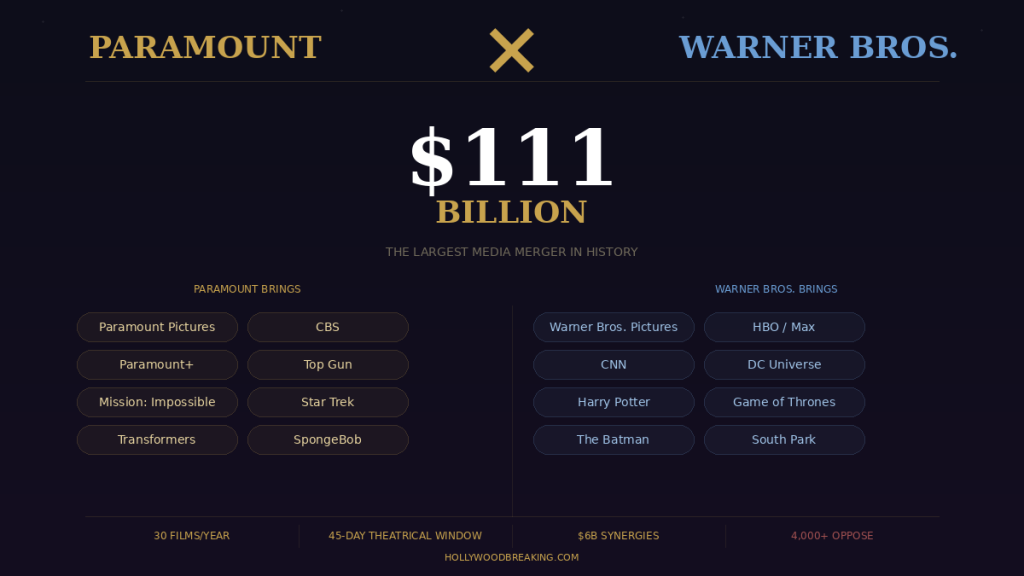
The numbers alone are staggering. Under one corporate umbrella, Paramount-Warner Bros. would control HBO, HBO Max, Paramount+, CBS, CNN, Warner Bros. Pictures, Paramount Pictures, New Line Cinema, DC Studios, the Harry Potter franchise, Game of Thrones, the DC Universe, Mission: Impossible, Top Gun, SpongeBob SquarePants, South Park, and dozens of other marquee properties. The combined entity would operate two of America’s most prominent news brands — CBS News and CNN — alongside one of the largest theatrical film operations in the world.
Ellison has pledged that Paramount Pictures and Warner Bros. will each produce a minimum of 15 theatrical films annually after the merger, creating a combined output of 30 movies per year. According to a California Policy Center analysis, that would represent a 58 percent increase over the studios’ recent combined production and could generate nearly $1 billion in annual movie production investment, supporting an estimated 40,000 jobs across production and related industries. Ellison has also committed to maintaining a 45-day theatrical window for all releases — a significant gesture at a time when the line between theatrical and streaming debuts has been steadily eroding.
The streaming implications are equally enormous. If HBO Max and Paramount+ are combined into a single platform — a move widely expected, though not yet formally announced — the resulting service would house one of the deepest content libraries in existence: from The Sopranos and Succession to Yellowstone and Star Trek, from The Batman to Top Gun: Maverick. It would represent the most formidable streaming challenger to Netflix and Disney+ yet assembled.
The Opposition
And yet, the creative community is overwhelmingly, vocally opposed.
The open letter published in the New York Times in early May and signed by over a thousand prominent industry figures was unequivocal: “We write to express our unequivocal opposition to the proposed Paramount–Warner Bros. Discovery merger. This transaction would further consolidate an already concentrated media landscape, reducing competition at a moment when our industries — and the audiences we serve — can least afford it.”
The signatories’ core argument is straightforward: fewer studios means fewer films, fewer shows, fewer jobs, and less creative diversity. The merger would reduce the number of major U.S. film studios from five to four. The precedent they point to is the Disney-Fox deal of 2019, which, according to multiple analyses, led to significant layoffs, shuttered production divisions, and a narrower range of projects greenlit under the combined operation.
Damon Lindelof, the Watchmen and Lost creator who is currently under an overall deal with HBO, explained his decision to sign despite knowing Ellison personally and considering him “bright, ambitious, and passionate.” His concern was not with Ellison’s intentions but with the structural consequences for the industry’s workforce. “It’s thousands and thousands of grips and gaffers,” Lindelof wrote. “Drivers and decorators. Builders and boom operators. Camera teams and caterers. And they’re all about to get fucked.”
Mark Ruffalo, who has emerged as one of the most vocal opponents, has spoken publicly about the fear of retaliation that initially silenced many colleagues. The Ellison family’s reputation for responding aggressively to criticism, combined with their growing control over major media platforms, created an environment in which speaking out felt genuinely risky. The fact that so many eventually did — and that the list includes working directors and actors with active studio deals — speaks to the depth of the anxiety.
The Political Dimension
The merger also carries significant political implications. Upon closing, Paramount Skydance would be approximately 38.5 percent owned by the sovereign wealth funds of Saudi Arabia, the United Arab Emirates, and Qatar — though these investors would hold non-voting shares. Critics have questioned the optics and governance implications of Middle Eastern sovereign capital holding a substantial stake in a company that controls CBS News and CNN. Others have focused on the Ellison family’s relationship with the Trump administration, raising concerns about whether antitrust review will be conducted with genuine rigor.
California’s attorney general, Rob Bonta, has indicated he will scrutinize the deal. Democratic lawmakers, including Senator Adam Schiff and Representative Laura Friedman, have requested detailed information on the merger’s impact on U.S. production, union jobs, AI safeguards, and competition. On Capitol Hill, Senator Cory Booker framed the stakes plainly during a recent hearing: “Not just a corporate deal is at stake — but who controls news, who controls entertainment, who controls storytelling.”
The Argument for the Deal
Proponents — led by Ellison himself — argue that consolidation is not just inevitable but necessary. The entertainment industry is under structural siege: from declining linear viewership, from streaming economics that have proven far harder to make profitable than anyone predicted, from the rising costs of tentpole production, and from competition with technology giants whose resources dwarf those of any traditional studio. In this reading, a larger Paramount-Warner Bros. is not a threat to creativity but its best chance of survival — a company with the scale to invest in theatrical releases, the IP library to compete with Netflix and Disney, and the financial resilience to weather the industry’s ongoing transformation.
The 30-film annual commitment and 45-day theatrical window are designed to address filmmaker concerns directly. The projected $6 billion in synergies — driven by technology integration, procurement savings, and operational streamlining — are meant to demonstrate that the combined company can be leaner without being smaller. Whether those promises survive contact with reality is, of course, the question that every previous megamerger in entertainment history has ultimately answered in the negative.
What Happens Next
The transaction awaits regulatory clearance from authorities in the United States and internationally. The DOJ’s posture under the current administration remains unclear. The California attorney general’s review could introduce complications. And while the shareholder vote in April was decisive, the stock market’s initial reaction — Paramount shares fell nearly 6 percent on the day of the vote — suggested that investors, too, harbor uncertainties about execution.
For Hollywood’s creative community, the fight is far from over. Jane Fonda’s Committee for the First Amendment called the shareholder vote “a serious setback” but insisted the campaign would continue. BlocktheMerger.com remains active. And the broader conversation about media consolidation — about who gets to decide which stories are told, and how many people are employed to tell them — has only intensified.
David Ellison, for his part, has tried to project confidence and sincerity. At CinemaCon last month, he looked directly at an audience of theater owners and filmmakers and said: “I love cinema and I love film. You can count on our complete commitment.”
Whether that commitment can coexist with a $111 billion deal, $6 billion in targeted synergies, and the brutal arithmetic of modern corporate consolidation is the question that will define not just this merger, but the next era of Hollywood itself.
The Deal at a Glance
- Price — Paramount will pay $31 per share in cash for all outstanding WBD shares, valuing the company at $81 billion in equity and approximately $111 billion including debt.
- Timeline — Expected to close in Q3 2026, pending regulatory clearance. A “ticking fee” of $0.25 per share per quarter kicks in after September 30 if the deal hasn’t closed.
- Combined Assets — HBO, HBO Max, Paramount+, CBS, CNN, Warner Bros. Pictures, Paramount Pictures, DC Studios, New Line Cinema, and franchises including Harry Potter, Game of Thrones, Top Gun, Mission: Impossible, and SpongeBob SquarePants.
- Production Commitment — 30 theatrical films per year minimum, with a guaranteed 45-day theatrical window.
- Projected Synergies — Over $6 billion, driven by technology integration, operational efficiencies, and consolidated streaming infrastructure.
- Opposition — Over 4,000 industry professionals have signed open letters opposing the deal. Featured signatories include Joaquin Phoenix, David Fincher, Denis Villeneuve, Jane Fonda, Lin-Manuel Miranda, Bryan Cranston, and Mark Ruffalo.
- Ownership — Post-close, approximately 38.5% of the company will be owned by sovereign wealth funds from Saudi Arabia, the UAE, and Qatar, though without voting shares. The Ellison Trust is providing a $45.7 billion equity commitment, guaranteed by Larry Ellison.
Hollywood Breaking will continue to cover the Paramount–Warner Bros. merger as regulatory review proceeds. Follow us for updates on the deal’s timeline, industry reaction, and implications for the future of entertainment.